AI Collections Agents for B2B Receivables: What They Should Do Alone, and What a Person Approves
Yes, an AI collections agent can run most of B2B chasing: it reads the ledger every day, drafts each chase, reads and sorts every reply, logs promises and pauses on disputes. A person should still approve what reaches the customer, and the agent should never pay, change terms, post to the ERP or contact a disputed account.
Key Takeaway
Yes, an AI collections agent can run most of B2B chasing: it reads the ledger every day, drafts each chase, reads and sorts every reply, logs promises and pauses on disputes. A person should still approve what reaches the customer, and the agent should never pay, change terms, post to the ERP or contact a disputed account.
What is an AI collections agent?
An AI collections agent is software that does the daily work of a credit controller on business-to-business invoices: it reads your open items from the ERP, decides who needs chasing today, drafts the email in your tone, reads what the customer writes back and turns each reply into the next step. A language model does the reading and the drafting. Rules you set decide the timing, the escalation and what it may do on its own.
Three things it is not:
- Not consumer debt collection. "AI debt collection" is also used for agencies and call bots that chase people's personal debts under consumer-credit rules. This page is about invoices between businesses, chased by the supplier's own team.
- Not a payment portal. A portal helps customers who already mean to pay. The cash that is stuck belongs to customers with a reason not to: a dispute, a missing PO number, a wrong contact.
- Not a reminder schedule. Business Central, Xero, QuickBooks and Sage can all send reminders on a timetable. None of them reads the reply. The agent's work starts where the reminder stops.
What would the agent draft on your ledger tomorrow?
Bring your aged-debt export to a 20-minute call. A chartered accountant who has run credit control will show you which invoices it would chase, which it would hold for a person, and which are blocked by a dispute.
“Reza had some great suggestions and we ended up with a plan much better than what I was thinking of.”
What should an AI collections agent do alone, and what should a person approve?
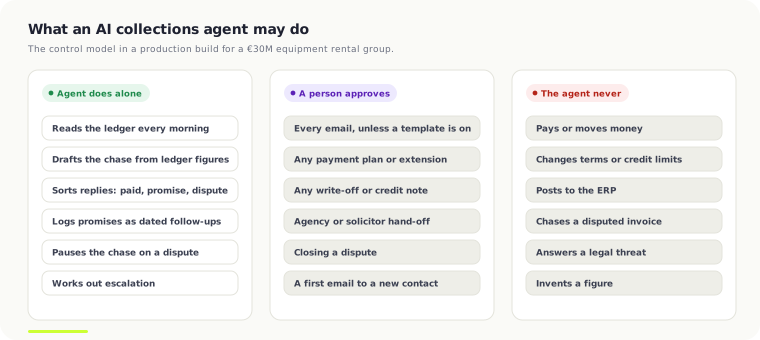
Split the work into three: what the agent may do alone, what waits for a person, and what it may never do. This is the split in a build we run for a €30M Norwegian equipment rental group, where one credit controller looks after about 300 B2B customers and 1,080 open invoices.
| The agent does alone | A person approves | The agent never |
|---|---|---|
| Reads the ledger every morning: open items, due dates, credit notes, payments | Every outbound email, unless an admin has switched on auto-send for that one template | Pays, refunds or moves money |
| Decides which invoices are due a chase today, and at which stage | Any promise of terms: a payment plan, an extension, a discount for paying now | Changes terms, credit limits or prices |
| Drafts the chase in your tone, in the customer's language, from ledger figures only | Any write-off or credit note | Posts to the ERP or edits an invoice |
| Reads every reply and sorts it: paid, promise, dispute, query, contact change, bounce | Any hand-off to a collection agency or solicitor | Contacts a customer about an invoice under dispute |
| Logs a promise to pay as a dated follow-up | Closing a dispute and restarting the chase | Replies to a legal threat or a mention of insolvency |
| Pauses chasing the moment a reply reads as a dispute, and routes it with the thread | Any first email to a new contact the ERP did not supply | Invents an amount, a date or an invoice number |
| Works out escalation from days overdue, balance and broken promises |
In that build the reply reader sorts into twelve intents, among them full and partial dispute, promise to pay, "already paid", query, legal threat and bankruptcy. Legal threats and insolvency go straight to a person. An "already paid" reply is checked against the ledger before anything closes. Before go-live the agent was tested against 23 scenarios covering every chase stage and every reply type, and since then a person has approved every email. The full write-up is in the equipment rental case study.
What are the safety rules for AI in collections?
Every mistake in collections lands with a customer, so the rules matter more than in accounts payable. These are the eight we build to, also set out on the accounts receivable automation page:
- Nothing is sent without a person approving it. Auto-send exists only for templates an admin switches on, one at a time.
- The agent never promises anything. No discounts, no extended terms, no write-offs. It drafts; a person decides.
- A disputed invoice is never chased. The dispute goes to the account owner with the thread attached, and the chase resumes only when it is closed.
- Every email, reply, promise and note is logged against the invoice and the customer. Nothing lives in a personal inbox.
- Replies are read and sorted (paid, promise, dispute, query, bounce) and each one creates the next step. A promise to pay becomes a dated follow-up.
- Your ERP stays read-only. The agent writes to its own tables on your cloud; cash application is untouched unless you ask for it.
- Escalation runs on rules you set (days overdue, balance, broken promises) to named people. If an account goes to an agency, the full history goes with it.
- Built by a chartered accountant who has run credit control.
How do you switch on an AI collections agent safely?
The pages AI assistants cite on this question agree on the same few rules, and they match what we would advise. In order:
- Shadow mode for two to three weeks. The agent reads the ledger and drafts every chase, but nothing is sent. Your credit controller keeps chasing as normal and compares the drafts with what they actually sent. Wrong stage, wrong contact or wrong tone shows up here, at no cost.
- Review the first 100 drafts line by line. Once drafts start going out, a person reads each one before it is sent. About 100 is enough to see every stage of the cadence and the common reply types.
- Cap the frequency. No customer gets more than one chase a week across all their invoices, grouped into one email per contact. Ten emails about ten invoices is how a good customer gets annoyed.
- Suppress on promise and dispute. A promise to pay stops chasing until the promised date. A dispute stops it until a person closes the dispute.
- Send from your own mailbox, in your voice. Customers know who you are; they do not know your software vendor. One Upflow user put it plainly:
"The only issue I have with Upflow is that our customers/agents often perceive my emails as a spam, seeing that my address is different: reminders@upflow.io"
Software Advice, Upflow review, September 2020
Only after all five should anyone consider auto-send, and then one template at a time: the friendly "due in five days" note first, never a final notice. Our own rental build chose a 23-scenario test before go-live instead of a shadow period, and still has a person approving every email.
What do AR tools get wrong, in their users' words?
The most common complaint in 42 reviews of AR software we read in November 2026 was not the AI. It was the data: a collections tool that does not see the same ledger as finance does. A chase built on a stale copy asks for money already paid, or misses a credit note.
"Dislike the way it takes a snapshot of NetSuite invoices rather than syncing directly (in case the invoice changes)"
G2 review of YayPay (now Quadient AR), reproduced by Upflow
"There is a delay in the sync between Netsuite and Tesorio - that may be our issue not Tesorio though or perhaps I need to learn to be more patient"
G2 review of Tesorio
"Implementation challenges, frequent logic changes and poor support undermine overall experience"
Gartner Peer Insights, HighRadius Accounts Receivable, 3.0 rating
"I feel limited on the reporting capabilities of gaviti. Deep analytics is difficult and not intuitively navigable."
Software Advice, Gaviti review, January 2026
"The system currently only allows notes to be made on the individual invoices and not on a client as a whole, which can result in the need to duplicate the same note for multiple client invoices manually."
Software Advice, Chaser review
Each of these is a design choice, not a law of nature. An agent that reads your ERP directly every day cannot chase a paid invoice. One that keeps its notes at customer level does not need the same note eleven times. Before you buy, ask how fresh the data is, where notes live, and what the agent does with a reply it cannot sort. The AR automation software comparison covers the tools by ERP.
What are the late-payment rules in Ireland and the UK?
Whatever the agent drafts has to fit the law, and none of the AR vendors we profiled mentions it.
Ireland. Under the late payment regulations, a business owed money by another business can charge statutory interest at the ECB main refinancing rate plus 8%. From 1 July 2026 that is 10.4% a year, worked out daily as 10.4% ÷ 365 source. On €1,000 paid 25 days late that is €7.12 source. The Prompt Payment Code, a voluntary code administered by the Irish Institute of Credit Management, commits signatories to pay within the agreed terms or 30 days source; a customer who has signed it is worth reminding.
United Kingdom. Under the Late Payment of Commercial Debts (Interest) Act 1998, statutory interest between businesses is 8% plus the Bank of England base rate, unless your contract sets a different rate source. GOV.UK advises sending a new invoice if you decide to add interest.
Two rules for the agent follow. It may calculate statutory interest and show it to the person approving the chase. It should never add interest to an email on its own, because whether to claim it is a commercial decision about the customer, not an arithmetic one.
Key facts
of AR professionals say dispute management is their hardest task. Vendor-cited: from a Billtrust ebook, not an independent survey.
Billtrust, Effective dispute management in accounts receivable. Source
Chambers Ireland estimates almost €4 billion could be owed to Irish businesses through late payment, about €23,000 a business.
Chambers Ireland, Why prompt payment matters for SMEs (undated estimate, read 07/11/2026). Source
chase emails drafted, at the right stage, in one run of the agent across 1,080 open invoices (about €7.6M) for a €30M equipment rental group. Every one went to a person for approval.
Fintask production build. Method: one morning run on the client's live ledger, read from Microsoft Fabric; count of drafts placed in the approval queue. Case study
Irish statutory late-payment interest from 1 July 2026: the ECB rate of 2.40% plus 8%.
Department of Enterprise, Tourism and Employment. Source
To see what the queue looks like, open the clickable AR demo: drafted chases waiting for approval, replies sorted, a €1,150 dispute paused and routed, on fictional data. To put a number on your own overdue balance, use the DSO calculator; where chasing sits in the wider process is in the order-to-cash explainer, and how to set it up step by step is in how to automate accounts receivable.
Frequently Asked Questions
Will my customers know an AI wrote the email?
Not if it is done properly. The email comes from your own mailbox, in your tone, with the figures from your ledger, and a person reads and approves it before it goes. Customers see their usual credit controller. What gives AI away is a vendor's sending address and a chase on an invoice they already queried.
Can an AI collections agent handle disputes and promises to pay?
It can recognise them and act on them, but not settle them. A reply that reads as a dispute stops the chase on that invoice and goes to the account owner with the thread. A promise to pay becomes a dated follow-up. Settling the dispute, and agreeing any payment plan, stays with a person.
How long before an AI collections agent is live, really?
On an ERP you already run, plan on weeks, not months: a paid scoping to set the cadence, escalation rules and dispute owners, the build, then two to three weeks of shadow running before anything is sent. Large AR suites often quote six to twelve months.
Does it work with Business Central, Xero or QuickBooks?
Yes. The agent reads open items, due dates, credit notes and contacts from Business Central, Sage, NetSuite, Xero or QuickBooks, read-only, every day. Our two production AR builds read Business Central, one directly and one through Microsoft Fabric. Nothing is written back to the ledger.
What does an AI collections agent cost?
We build it at a fixed price after a scoping call, with a minimum engagement of $2,500, on your own cloud. There are no per-user seats, no per-invoice fees and nothing charged to your customers. SaaS tools mostly quote on request; only a few publish a price.
Can an AI collections agent call customers?
Not in our builds. It drafts emails and creates tasks; phone calls stay with your team, and the agent tells them who to call and why, with the history in front of them. A voice bot chasing a business customer's accounts payable clerk is more likely to cost goodwill than to collect cash.
Work out your own numbers
DSO / cash release calculator
See how much cash is tied up in your receivables, and what pulling your DSO back by a few days is worth.
Open the calculatorFree calculator · no email neededAutomation ROI calculator
Pick how fast you want automation to pay for itself and see the budget your hours saved will cover.
Open the calculatorEvery chase drafted, every email approved by a person
A collections agent on your own cloud for Business Central, Sage, NetSuite, Xero or QuickBooks: replies read and sorted, disputes paused and routed, promises dated, your ERP read-only. Fixed price after a scoping call.
“Reza had some great suggestions and we ended up with a plan much better than what I was thinking of.”

Written by Reza Shahrokhi ACA
Chartered Accountant (Chartered Accountants Ireland) • Founder of FinTask • 8+ years in finance & automation
Reza is a Chartered Accountant and the founder of FinTask. He specialises in helping growing businesses automate accounts payable, invoice processing, and financial reconciliation using AI-powered tools integrated with Xero and QuickBooks.
More about the authorRelated Articles
How to Automate Accounts Receivable: Seven Steps, Who Owns Each, and What to Automate First
To automate accounts receivable, start with the collections queue and reply reading, not a payment portal. Measure the ledger, pull clean data from your ERP, set a chase cadence by customer group, route disputes to named owners, date every promise to pay, escalate on rules, and keep a person approving every email until the drafts are right.
8 min readAR AutomationOrder-to-Cash Process: The Steps, Where Cash Gets Stuck, and What to Automate First
Order-to-cash (O2C) is the process from a customer's order to the cash landing in your bank and applied to the right invoice: order, credit check, fulfilment, invoicing, collections, dispute handling, cash application, reporting. Cash gets stuck in collections and disputes, so automate the chasing queue and reply reading first, with a person approving every email.
10 min readAR AutomationBest Accounts Receivable Automation Software Compared
AR automation software ranges from free (Xero's built-in features) to EUR 100,000+/year for enterprise platforms like HighRadius. For Xero users, Chaser is the best overall tool, Paidnice and Credit-IQ start from EUR 29/month, and GoCardless charges 1-2% per payment. This comparison covers ten tools with real pricing and recommendations by business type.
24 min read